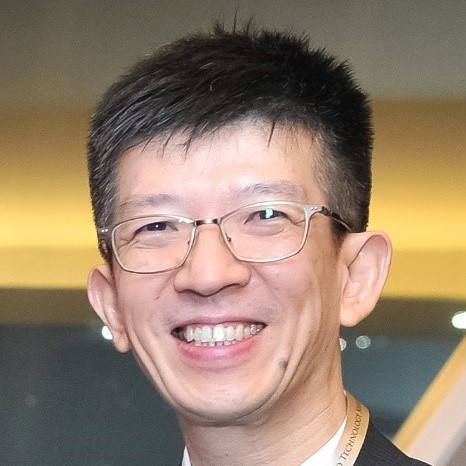
HaizhouLi
Haizhou Li received the B.Sc., M.Sc., and Ph.D degree in Electrical and Electronic Engineering from South China University of Technology, Guangzhou, China. He is currently a Professor at the Department of Electrical and Computer Engineering, National University of Singapore (NUS). Prior to joining NUS, he was the Principal Scientist and Department Head of Human Language Technology in the Institute for Infocomm Research, Singapore (2003-2016). Prof. Li’s research interests include speech information processing, natural language processing, and human-machine interface. Prof. Li has served as the Editor-in-Chief of IEEE/ACM Transactions on Audio, Speech and Language Processing (2015-2018), a Member of the Editorial Board of Computer Speech and Language (2012-2018), and a Member of IEEE Speech and Language Processing Technical Committee (2013-2015). He was the President of the International Speech Communication Association (ISCA, 2015-2017), the President of Asia Pacific Signal and Information Processing Association (2015-2016), and the President of Asian Federation of Natural Language Processing (2017-2018). He was the General Chair of ACL 2012, INTERSPEECH 2014, and IEEE ASRU 2019. Prof. Li is a Fellow of the IEEE, and a Fellow of ISCA. He was a recipient of the President’s Technology Award 2013 in Singapore. He was named one of the two Nokia Visiting Professors in 2009 by the Nokia Foundation, and U Bremen Excellence Chair Professor in 2019 by Bremen University, Germany.
Title: Recent Advances in Selective Auditory Attention
Abstract: Humans have a remarkable ability to pay their auditory attention only to a sound source of interest, that we call selective auditory attention, in a multi-talker environment or a Cocktail Party. However, signal processing approach to speech separation and/or speaker extraction from multi-talker speech remains a challenge for machines. In this talk, we study the deep learning solutions to monaural speech separation and speaker extraction that enable selective auditory attention. We also introduce their applications in speech recognition, speaker recognition, and hearing aids. We discuss the computational auditory models, technical challenges and the recent advances in the field.
Where
Canberra, Australia
When
1-4 December 2020
ieeessci2020 at gmail . com